Here's a preview of the Minneapolis Murals Project I'm working on. I used Google Fusion Tables to create this map. I'll be able to add other projects to the same map as they come on line. I'll only publish the murals now because it's the one project where the audio is actually ready.
Soon the audio will be available on-site via SMS/phone and hopefully we'll get a mobile web site up as well.
Thursday, May 26, 2011


Wednesday, April 20, 2011
Signs for Placecasting
As I work on creating a few sets of Placecasts around Minnesota, I'm thinking about what the signs should look like to let people know the audio is available. I'm going to collect sign images here. Feel free to send some in:
I found this at the Lincoln Memorial one night. Simple cell phone interface with a good preview of the topics:

A much more mysterious set of signs in Toronto. No hint of the content, but high "cool" factor that must have generated calls:

I found this at the Lincoln Memorial one night. Simple cell phone interface with a good preview of the topics:

A much more mysterious set of signs in Toronto. No hint of the content, but high "cool" factor that must have generated calls:
Sunday, June 6, 2010
A Mansion, a Museum and Music
Some placecasts I've seen in the news recently:
 |
| The Vanderbilt Breakers Mansion |
- A Seattle Post Intelligencer blogger mentions the audio tour of the famous Breakers Mansion in Newport, Rhode Island this week. A two hour tour sounds too long to me in an old house, but there are 20 bathrooms to get through. The tour sounds like much more than narration. It includes sound effects (which can be a great touch or profoundly cheesy) and oral histories from people who lived at the mansion. The audio producer's description of the tour is actually a great read and includes these details:
(Speaking of Rhode Island, here's a great short audio story from NPR on Friday about R.I.'s famous weenies. I wonder if the Vanderbilts served these at garden parties...)"'The push for audio tours grew out of an effort “to become more relevant and engaging for our visitors and to move away from a specifically fact-based guided tour,” said John Tschirch, the preservation society’s architectural historian and director of academic programs....The recording includes narration, sound effects, commentary from architectural experts and past servants, and readings of memoirs of Vanderbilt family members...'You entered the house as a Vanderbilt or guest, now you entering the dining room as a servant' is the new approach of the audio tour, which relies on hallways used by servants that weren’t open for guided tours."
- A National Geographic exhibit currently at The Franklin Institute in Philadelphia is using the voice of Cleopatra to narrate an audio tour if it's exhibit all about...Cleopatra. According to a story in Philly.com: "After a five-minute video introduction, an audio tour delivered as if the queen herself were speaking, fills visitors in on the details of her life." Yikes. The writing and voicing had better be exceptional to pull this sort of thing off. But the audio tour sounds old-school compared to the other features of this high-tech exhibit: "The exhibit includes high definition multimedia, original soundscapes and a mobile-based social media scavenger hunt." National Geographic knows a lot about education and interpretation, so I'm very curious to hear how this exhibit is received.
- The award-winning Toronto Music Garden is packed with music and dance from now through September. The outdoor garden and performance space is, literally, inspired by Bach (for example, the "Prelude" is a "An undulating river scape with curves & bends", followed by the "Allemand", "A forest grove of wandering trails"...etc.) In a $6 70-minute audio tour now available near the park, cellist Yo-Yo Ma and landscape architect Moir Messervy explain how they turned music into a park. This concept is so well tailored for placecasting that I'd be disappointed if such a tour wasn't available. (via Music Industry Mews Network)

Toronto Music Garden (via City of Toronto)

Saturday, March 13, 2010
Art and audio in the aisles
Grocery stores are dizzying places. So many choices. So much information. Flashy packaging. Conflicting priorities. I've stood staring and hopeless at the wall of soup cans too many times to count. Do I choose price or flavor or nutrition or ingredient or serving size or natural or local? If Donovan McNabb's mother eats this soup, shouldn't I?
 So how nice would it be if someone replaced those voices in my head with an artful, musical take on the grocery store experience? Apparently, Rotozaza has done that. The UK-based artists have produced a half-hour audio tour of the supermarket -- ANY supermarket with more than 10 aisles.
Director Silvia Mecuriali is quoted in this Australian newspaper story:
But here's what's interesting. This is a placecast that isn't tied to a specific place, but rather to a KIND of place. The audience has to be somewhere to appreciate it, but not necessarily in the same place it was recorded. This works because grocery stores in much of the world now have more similarities than differences -- a fact worthy of reflection in itself.
This isn't historical interpretation, but rather societal deconstruction. And audio is still the perfect medium. "Wearing headphones and anonymous behind your trolley [shopping cart]," the project's Web site says, "you are guided around the aisles immersed in a private world, as the carefully constructed sound scape overlays a fictional world that blurs the real with the imaginary."
 Using sound as the primary medium allows the audience to still participate in the physical world, while their thoughts about that place are being directed and informed by the audio program. There's no need to stare at a smartphone screen or tap away on a laptop keyboard.
What other places in our world are similar enough for this kind of placecast? Would it work anywhere beyond the homogeneous world of retail stores, fast food joints...maybe airports?
I'll explore this whole concept further, driven in part by this intriguing line from the Rotozaza Wondermart press release:
(photos by Ant Hampton via Rotozaza)

Director Silvia Mecuriali is quoted in this Australian newspaper story:
“It plays around with the ideas of consumerism, reclaiming public space and using it in a different way,” Mercuriali said.
“It takes a mischievous swipe at the dominance of supermarket culture and consumerism.”
But you don’t have to buy anything and the people around you become extras in your own private “guerrilla-style” show.
The 30-minute tour guides the shopper through food sections, with the music changing to reflect the frozen food area, dairy, and fruit and vegetables.I'll review the audio if I can get a copy -- right now it's only available to people who buy tickets for another theater performance in Melbourne.
But here's what's interesting. This is a placecast that isn't tied to a specific place, but rather to a KIND of place. The audience has to be somewhere to appreciate it, but not necessarily in the same place it was recorded. This works because grocery stores in much of the world now have more similarities than differences -- a fact worthy of reflection in itself.
This isn't historical interpretation, but rather societal deconstruction. And audio is still the perfect medium. "Wearing headphones and anonymous behind your trolley [shopping cart]," the project's Web site says, "you are guided around the aisles immersed in a private world, as the carefully constructed sound scape overlays a fictional world that blurs the real with the imaginary."

What other places in our world are similar enough for this kind of placecast? Would it work anywhere beyond the homogeneous world of retail stores, fast food joints...maybe airports?
I'll explore this whole concept further, driven in part by this intriguing line from the Rotozaza Wondermart press release:
Rotozaza are the pioneers of Autoteatro, a new kind of performance where, by receiving and following instructions through headphones, audience members assume the roles of both actor and observer and thereby create a self-generating piece of theatre.Of course that makes everyone else in the supermarket unwitting extras in your own private performance. This sounds so much better than staring at soup cans.
(photos by Ant Hampton via Rotozaza)
Saturday, January 9, 2010
T.O.U.R. in the USA - A Mellencamp audio tour
Seymour, Indiana has been trying to cash in on its most famous former resident for a long time. Indeed, rocker John Mellencamp's heartland mystique is "one of the larger attractions to the area" according to Jackson County Visitor Center director Tina Stark.

Now, Cougarphiles and rock pilgrims can roam Seymour with a CD driving tour featuring Mellencamp memories, factoids and music.
Did you know the Mellencamps have lived in Jackson County for 150 years? Did you know John's mother threw out his first written songs? Do you know who ELSE is on the Seymour High School Wall of Fame? The tour knows...
From the Seymour Daily Tribune:
 The CD is apparently only available at the visitors center, so I haven't been able to preview it. But I'm optimistic that it's more than tourist schlock. What gives me hope is that so much of Mellencamp's music is rooted in place and memory. He both celebrates and laments the qualities of small town Middle America.
So fans will recognize the significance of tour stops like Larrison’s Diner and the Rok-Sey Roller Rink -- even if they're not directly referenced in Mellencamp songs. Also, any tour creator who seeks out interviews with former girlfriends must understand the power of oral history in placecasting. And in this interview with NPR's Fresh Air, Mellencamp talks about how his early experience with racial issues still affect his lyrics today. If the tour can connect those dots between place, people and art, it should be worth the time (and the $14 price tag).
Now I wonder how many little pink houses are along the route.
(Here's a more detailed review of the tour from Jane Ammeson, of the Northwest Indiana Times)
(Main street Seymour photo from a very nice placeblog about U.S. Route 50 called Rte50.com)

Did you know the Mellencamps have lived in Jackson County for 150 years? Did you know John's mother threw out his first written songs? Do you know who ELSE is on the Seymour High School Wall of Fame? The tour knows...
From the Seymour Daily Tribune:
“It was originally just the brochure, but we were looking for a way to creatively put together a new experience for our visitors,” Stark said. She said the CD offers information the listener could not have gotten anywhere else and moreThe audio tour has been in the works for five years. Stops include Mellencamp's boyhood home, his junior high and high school and several other local landmarks.personal information about Mellencamp.
Those lending their memories and stories about Mellencamp are his mother, brother, sister, former teacher, friends and former girlfriends.
The tour is narrated by Dan Osborne and features 16 of Mellencamp’s hit songs, including “Small Town,” “Human Wheels” and “R.O.C.K. In the USA.”
 The CD is apparently only available at the visitors center, so I haven't been able to preview it. But I'm optimistic that it's more than tourist schlock. What gives me hope is that so much of Mellencamp's music is rooted in place and memory. He both celebrates and laments the qualities of small town Middle America.
So fans will recognize the significance of tour stops like Larrison’s Diner and the Rok-Sey Roller Rink -- even if they're not directly referenced in Mellencamp songs. Also, any tour creator who seeks out interviews with former girlfriends must understand the power of oral history in placecasting. And in this interview with NPR's Fresh Air, Mellencamp talks about how his early experience with racial issues still affect his lyrics today. If the tour can connect those dots between place, people and art, it should be worth the time (and the $14 price tag).
Now I wonder how many little pink houses are along the route.
(Here's a more detailed review of the tour from Jane Ammeson, of the Northwest Indiana Times)
(Main street Seymour photo from a very nice placeblog about U.S. Route 50 called Rte50.com)
Friday, November 20, 2009
It's ready! Northstar rail audio tour
My audio tour of Minnesota's new Northstar Commuter Rail Line is ready to go. The service has been running for five days and now riders can learn a bit about the towns and cities along the way. This tour talks about some of the buildings along the route (like Minnesota's first car factory and its first nuclear power plant) and about the history of the corridor, which Canadian fur traders were traveling in oxcarts 190 years ago.
Download the audio tour here. (.mp3 file, 9.8mb...right-click to download)
Here's an enhanced iTunes version with chapters if you have an iPod. (left-click to go to iTunes)
 This audio file is meant to be used on the train, starting at Target Field in Minneapolis. It's one 20 minute file, broken into 5 chapters...one for each station. At the end of each chapter, it asks listeners to pause the audio until they leave the next station. There's about 20 minutes of information in all for the 51 minute trip.
I hope to create a second podcast for the inbound trip, but at the moment none of those morning trips happens during daylight hours.
If you listen to this podcast, I would LOVE to hear feedback. There's a lot more I want to do with this tape (add interviews and natural sound), and I want to know what you'd like to hear in the next version.
Download the audio tour here. (.mp3 file, 9.8mb...right-click to download)
Here's an enhanced iTunes version with chapters if you have an iPod. (left-click to go to iTunes)
 This audio file is meant to be used on the train, starting at Target Field in Minneapolis. It's one 20 minute file, broken into 5 chapters...one for each station. At the end of each chapter, it asks listeners to pause the audio until they leave the next station. There's about 20 minutes of information in all for the 51 minute trip.
I hope to create a second podcast for the inbound trip, but at the moment none of those morning trips happens during daylight hours.
If you listen to this podcast, I would LOVE to hear feedback. There's a lot more I want to do with this tape (add interviews and natural sound), and I want to know what you'd like to hear in the next version.
Tuesday, November 10, 2009
Podcasting Northstar
On Monday, I got to take a preview ride of the new Northstar Commuter Rail line from Minneapolis to Big Lake. For train geeks, the opening of the new line (it opens to passengers on Monday, Nov. 16) marks a hopeful new era for rail travel in Minnesota.
Practically, though, Northstar is about commuting to work...and not much more. The timetables are set to get people into Minneapolis in time to get to work and to get them back home shortly after work is done. Don't plan to stay downtown for a few drinks or a show because the last train out leaves at 6:10pm.

Nor should you expect to take a day trip from the city to beautiful Elk River. Downtown ER is a really nice place, with a great view of a meandering Mississippi River...but the Northstar station isn't anywhere near downtown. If you're daytripping, you'd better have someone ready to pick you up at the station.
All that said, Northstar will be great for thousands of commuters who want to avoid traffic on Hwy. 10 and relax a bit on the way to and from work. My project is to create a podcast for people who ride the line to learn about the places they'll see along the way.
The corridor from Minneapolis to St. Cloud along the east side of the river is full of history: it was one of the main oxcart trails to St. Paul from the Red River Valley from the 1820s to 1870s. Elk River housed the nation's first nuclear power plant. Big Lake was a major source of ice for Twin Cities ice boxes. Anoka is still home to Minnesota's first major mental health treatment center.
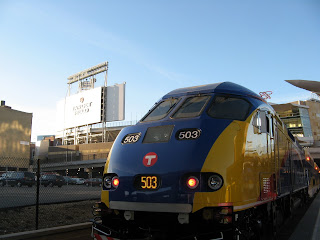
And of course there are the railroads. The Northstar runs along track laid by the St. Paul & Pacific Railroad in the 1860s. That track later became a key part of James J. Hill's Great Northern empire. Passenger trains ran along the line for over 100 years (actually, one still does: Amtrak's Empire Builder makes one run per day in each direction on its route from Chicago to Seattle). The rails are now owned by BNSF and that company's engineers will man the Northstar trains.
There are stories about American migration, agricultural and industrial development and our changing approach to living and working to be seen and heard on this train trip. I'm trying to compile those stories into a podcast that's both place-specfic and easy to digest. This isn't a lecture, it's a journey.
I hope the project will be done in the next couple weeks for any new riders of the line to enjoy. Because I critique a lot of podcasts here, I'm going to try to take a lot of my own medicine in the writing and producing. Wish me luck.
(Photos are mine.)
Practically, though, Northstar is about commuting to work...and not much more. The timetables are set to get people into Minneapolis in time to get to work and to get them back home shortly after work is done. Don't plan to stay downtown for a few drinks or a show because the last train out leaves at 6:10pm.

All that said, Northstar will be great for thousands of commuters who want to avoid traffic on Hwy. 10 and relax a bit on the way to and from work. My project is to create a podcast for people who ride the line to learn about the places they'll see along the way.
The corridor from Minneapolis to St. Cloud along the east side of the river is full of history: it was one of the main oxcart trails to St. Paul from the Red River Valley from the 1820s to 1870s. Elk River housed the nation's first nuclear power plant. Big Lake was a major source of ice for Twin Cities ice boxes. Anoka is still home to Minnesota's first major mental health treatment center.

There are stories about American migration, agricultural and industrial development and our changing approach to living and working to be seen and heard on this train trip. I'm trying to compile those stories into a podcast that's both place-specfic and easy to digest. This isn't a lecture, it's a journey.
I hope the project will be done in the next couple weeks for any new riders of the line to enjoy. Because I critique a lot of podcasts here, I'm going to try to take a lot of my own medicine in the writing and producing. Wish me luck.
(Photos are mine.)
Subscribe to:
Posts (Atom)


